.png)
Pest Profile: Ants
Ants are tiny but troublesome household invaders. While they might look harmless, when ants join forces in large quantities, they can do significant damage to your home in a short period of time. Specifically, there are four species of ants that often threaten homes and businesses – pharaoh ant, pavement ant, odorous house ant, and carpenter ant. Let’s take a closer look at each on this page.
Last Updated: March 29, 2026
Quick Facts about Ants
Ant Species Identification Guide
Identifying the correct ant species is the single most important factor in ant control. The wrong treatment approach for the wrong species can make the infestation dramatically worse especially with Pharaoh Ants.
✔ Carpenter Ant (Camponotus pennsylvanicus) — Ontario's largest ant at 6–25 mm with black or red-and-black colouring and single node between thorax and abdomen. The thorax is evenly round when viewed from the side. Carpenter Ant workers vary in sizes (polymorphic insects). They are present indoors around winter or spring and if they are seen, it means that an indoor satellite colony could be present.
✔ Pavement Ant (Tetramorium caespitum) — Small (2.5–3.5 mm) with dark brown to black colouring and two nodes. There are parallel grooves on the head and thorax. The most commonly seen ant on driveways and sidewalks foraging for food in a trail. They build nests under pavement slabs, concrete, and in wall voids.
✔ Odorous House Ant (Tapinoma sessile) — Small (1.5–3.2 mm) with dark brown colouring and one hidden node. When an Odorous House Ant is crushed, it emits a distinctive rotten coconut odour. They walk along wiring and plumbing inside walls. They form very large supercolonies and the colonies are highly resistant to disruption.
✔ Pharaoh Ant (Monomorium pharaonis) — Tiny (1.5–2 mm) with yellowish to light brown colouring. They have two nodes. As a tropical species, Pharaoh Ant cannot survive outdoors in Canada relying on heated buildings as their dwelling. They walk inside walls, conduits, and behind appliances.
Ant Terminology
Node - An ant node is a small bump or segment on the petiole (the narrow "waist" connecting the thorax and abdomen) of an ant and is used to identify species.
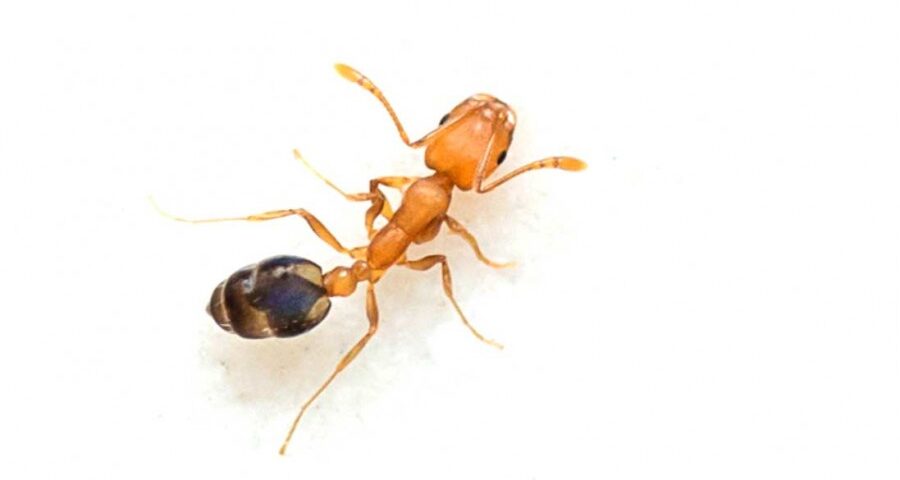
Image: Pharaoh Ant
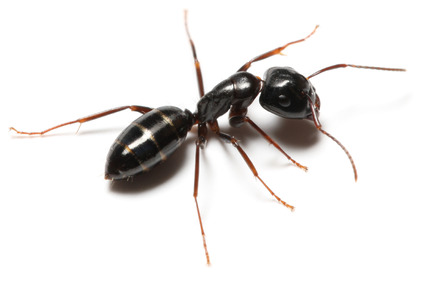
Image: Odorous House Ant
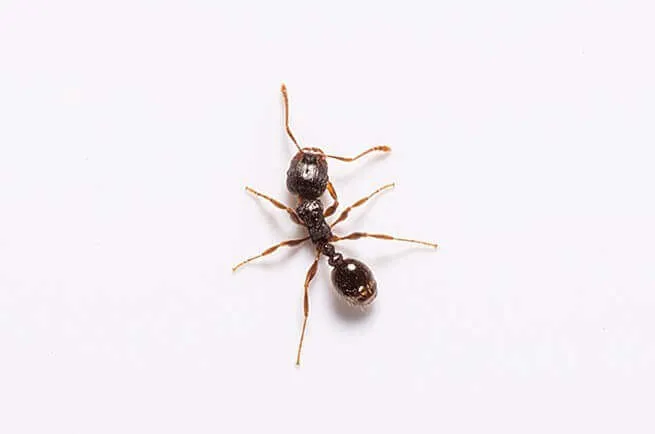
Image: Pavement Ant

Image: Carpenter Ant
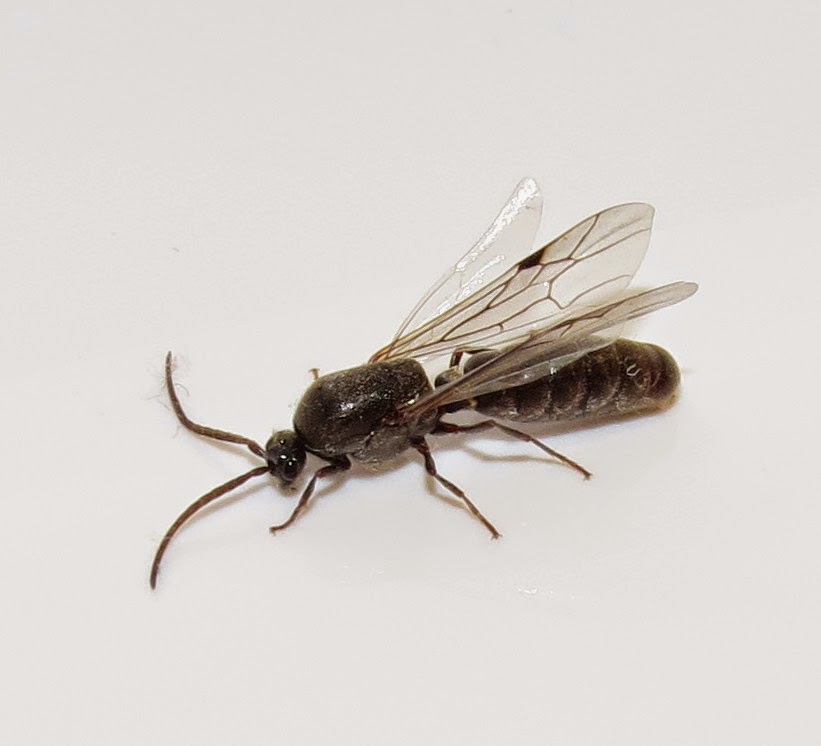
Image: Winged Ant (alate)
Winged ants (alates) are frequently confused with termite swarmers because both emerge in large numbers when the weather starts warming up.
Ants and Termites Key differences:
Ants have elbowed (bent) antennae, a narrow pinched waist, and forewings larger than hindwings.
Termites have straight, bead-like antennae, a broad uniform waist, and wings of equal length.
Both indicate an established colony but the treatment approach is entirely different. Never assume without professional identification.
Ant Behaviour & Biology
Ants are among the most social organisms on Earth. They have a complex colonial structure, chemical communication, and division of labour make them extraordinarily resilient.
- Superorganism & Caste Structure: An ant colony functions as a single superorganism. The structure starts with the queen (role: lay eggs), and sterile female workers (role: forage, maintain the nest, and brood caretaking), and males (role: mate and die). The queen's survival is the colony's survival which is why treatments that kill workers without affecting the queen or brood leave the colony intact and capable of fully recovering within weeks.
- Pheromone Trail Communication: Foraging ants deposit chemical trail pheromones that recruit nest mates to food sources. A single scout finding food can generate a visible trail of hundreds of workers within minutes. This is why ant trails appear and disappear seemingly overnight as they are chemically guided and self-reinforcing. By wiping visible trails away without treating the colony simply causes temporary disruption and does not reduce the population. There is a phenomenon called ‘ant death circle’ or "ant mill" where ants losing their main pheromone trail begin following each other in a continuously rotating circle until the group dies from exhaustion.
- Reproduction Via Budding: Most ant species respond to a perceived colony threat by 'budding'. One or more queens and a group of workers separate and establish a new satellite colony in a different location. This is the reason repellent sprays and insecticide barriers are catastrophically counterproductive against Pharaoh Ants and Odorous House Ants. The visible trails of spraying causes the colony to fragment and spread which turns one nest location into multiple nest problems.
- Food Sharing (Trophallaxis): Ants share food throughout the colony via trophallaxis, a transfer of liquid food from mouth-to-mouth. This behaviour is the mechanism that makes slow-acting bait products effective because a forager consumes bait, returns to the colony, and shares the toxic material. The treatment spreads to workers, brood, and ultimately the queen. Fast-acting contact insecticides that kill the forager before it returns to the colony impacts the treatment effectiveness by leaving the queen and colony unaffected.
- Seasonal Activity & Overwintering: Outdoor ant colonies overwinter by clustering deep in the nest below the frost line. In spring, colonies expand aggressively as temperatures rise. Carpenter Ants with indoor satellite colonies remain active year-round in heated spaces. If you see ants indoors in January or February, it means there is evidence of an established indoor nest and not just foragers entering from outside.
- Satellite Colony Structure: Many ant species maintain a parent colony (often outdoors in a tree or stump) and one or more satellite colonies inside the structure. This is especially in the case of Carpenter Ants. Satellite colonies house workers and larvae but typically no queen. Eliminating the satellite colony without treating the parent colony results in rapid recolonization so a comprehensive treatment must address both problems.
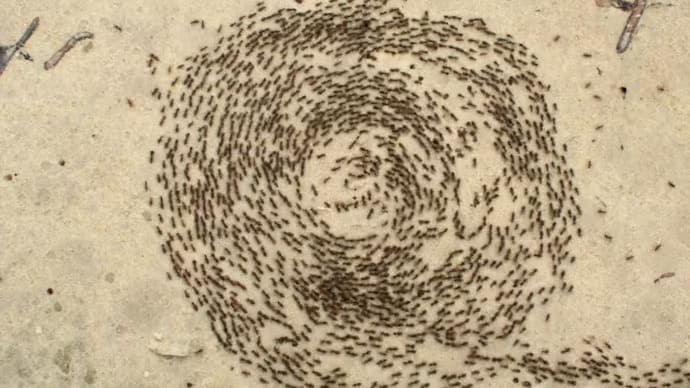
Image: Ant Mill or Ant Death Spiral
Ant Diet & What Attracts Them
Different ant species are attracted to different food types. By identifying what ants are foraging, it helps confirm the species for the pest management profession's treatment technique required and prevention recommendations.
Carpenter Ants Indicate a Moisture Problem: Carpenter Ants do not eat wood. They strongly prefer wood that has been softened by water damage, fungal decay, or rot to create smooth-walled galleries for nesting. So finding Carpenter Ants inside your home is not just a pest problem and means that there is underlying moisture issue such as a roof leak, plumbing leak, condensation problem, or failing exterior sealant. Treating the ants without addressing the moisture allows the colony to rebuild and the structural decay to continue.
Ant Reproduction & Swarming
Understanding ant reproduction is critical for correctly interpreting what you are seeing and responding appropriately. There's an event among Ants and Termites called the 'Annual swarming events' when winged reproductive ready adults leave their nests to mate and establish new colonies. This event occurs in Spring or Summer depending on weather conditions.
- Nuptial Flight (Swarming): Once a colony reaches maturity (Carpenter Ants take the longest at 3–6 years), it produces winged reproductive males and females (alates) that swarm in large numbers. You see them out in the open on warm and humid days in late spring or summer. Alates mate in flight where the males die and mated queens (sheds wings) lands to attempt to start new colonies. If you see a swarm of winged ants, it indicates a large, established, mature colony nearby.
- Queen Founding & Colony Growth: A newly mated queen (consuming no food) seals herself into a small cavity and raises her first cohort of workers entirely from her own fat reserves and wing muscles. This founding phase takes 2–4 months. Once the first workers emerge, the colony begins its expansion. Carpenter Ant colonies take 3–6 years to reach reproductive maturity, meaning a swarming colony has been established on or in your property for years.
- Colony Maturation Timeline: Small ant colonies (Pavement Ants and Odorous House Ants) reach reproductive maturity in 1–2 years. Pharaoh Ant colonies reproduce by budding year-round rather than swarming. Carpenter Ant colonies grow slowly taking 3–6 years to first swarm but once the colony is established, Carpenter Ant queens can live 20–30 years producing workers for decades. Long-established Carpenter Ant infestations require comprehensive treatment and not just surface spraying.
Carpenter Ants Structural Damage
Carpenter Ants are the only ant species that can cause significant structural damage to buildings. The other species are primarily a nuisance and food contamination concern.
- Galleries in Structural Wood: Carpenter Ants excavate smooth, clean galleries in wood removing frass (coarse sawdust with insect fragments) from the nest. Finding frass below a wall void, window frame, or wooden beam is a definitive indicator of active Carpenter Ant excavation. Galleries weaken structural members and can compromise the integrity of beams, joists, and framing over time.
- Moisture-Damaged Wood as Primary Target: Carpenter Ants target wood softened by moisture such as window frames with failing caulk, roof structures below a leak, deck ledger boards, and wall framing around plumbing penetrations. The combination of structural excavation and underlying water damage can lead to significant remediation costs. Our treatment assessment always includes identification of the moisture source.
- Electrical & HVAC Interference: Carpenter Ants frequently establish satellite colonies inside wall voids adjacent to electrical wiring and HVAC ductwork. Frass accumulation around wiring and ants nesting in junction boxes creates fire risk. Workers chewing insulation off wiring to expand gallery space is documented but less common than in rodent infestations.
Ant Health Risks
Most ant species present nuisance and food contamination concerns rather than direct health threats. However, there are several species that present genuine medical risks to humans.
⚠ Food Contamination — All foraging ant species contaminate food surfaces and stored food with bacteria carried from outdoor environments, garbage, drains, and decaying organic matter. Pathogens including Salmonella, E. coli, Staphylococcus, and Streptococcus have been isolated from ant bodies in food service environments. It is advised to toss food that has been contacted by Ants.
⚠ Pharaoh Ants in Healthcare Settings — Pharaoh Ants are classified as a serious medical pest. They can penetrate sterile packaging, IV bags, wound dressings, and patient care areas in hospitals and care homes settings worldwide. They transmit Salmonella, Clostridium, Pseudomonas, and Staphylococcus. Any Pharaoh Ant activity in a healthcare, food service, or vulnerable occupant environment requires immediate professional intervention.
⚠ Carpenter Ant Bites — Carpenter Ants do not sting but can deliver a painful bite and spray formic acid into the wound resulting in an intensifying burning sensation. Bites break the skin and may cause localized swelling. Allergic reactions to ant bites are possible but less common than with stinging species.
⚠ Allergic Reactions — Some individuals develop allergic responses to ant venom or formic acid. The reaction response ranges from localized swelling and hives with rare cases of anaphylaxis. Individuals with known hymenoptera venom allergies should be aware that ant bites and stings involve related venom compounds.
⚠ Psychological & Quality of Life Impact — Large indoor ant infestations involving Odorous House Ants and Pharaoh Ants in living spaces and food preparation areas can cause significant distress and are associated with anxiety. The persistent, recurring nature of ant infestations without professional treatment amplifies this anxiety.
Signs of Ant Activity in Your Home
By recognizing the difference between foraging trails entering from outside and an established indoor colony guides the treatment approach and urgency.
✔ Visible trails of workers — consistent lines of ants following established routes along walls, under doors, along plumbing, or across countertops.
✔ Frass below wooden surfaces — coarse sawdust-like material with insect fragment bits beneath wall voids, window frames, baseboards, or wood beams indicates Carpenter Ants.
✔ Winged ants (alates) indoors — particularly in late spring indicates a mature, established colony inside or immediately adjacent to the structure.
✔ Shed wings on windowsills — alates shed wings after mating so finding piles of detached wings near windows indicates a recent indoor swarm.
✔ Ants in winter — any ant activity indoors between November and March almost certainly indicates an established indoor colony and not foragers from outside.
✔ Hollow-sounding wood — tapping suspected Carpenter Ant areas may reveal a hollow sound from excavated galleries particularly within window frames, baseboards, and wooden beams.
✔ Rustling sounds in walls — large Carpenter Ant colonies produce a faint rustling or crackling sound inside wall voids at night.
✔ Ants emerging from electrical outlets or baseboards — ants coming out of electrical outlets and baseboards indicates a colony established inside the wall void. This is common for Carpenter Ants and Odorous House Ants satellite colonies.
Why Professional Treatment Is Essential
Ants are one of the pest categories where DIY treatment most frequently worsens the problem. Understanding the whys help guide homeowners toward professional intervention earlier.
- Repellent sprays cause budding: applying consumer insecticide sprays to ant trails particularly for Pharaoh Ants and Odorous House Ants can trigger colony fragmentation turning one nest into many.
- Contact killers miss the queen: killing foraging workers has no impact on the queen or brood because they never make it back to the colony to spread the treatment.
- Bait selection matters: different species require different bait formulations (protein-based vs. sugar-based vs. lipid-based) and incorrect bait is ignored.
- Colony location: the visible trail does not always lead to the colony. An effective treatment requires locating and treating the nest, not just the foragers.
- Carpenter Ant moisture source: treating the ants without identifying and repairing the moisture problem that attracted them will guarantee recolonization.
- Pharaoh Ant specialist treatment: Pharaoh Ant control requires non-repellent slow-acting bait placed by a professional in specific locations because no other approach is consistently effective.
- Multi-colony systems: Carpenter Ant satellite colony systems require treatment of both indoor satellite and outdoor parent colony as the permanent resolution.
Our licensed technicians identify the ant species accurately before any treatment begins, locate the colony and all satellite nests, apply the appropriate combination of slow-acting non-repellent baits, residual perimeter treatments, and targeted nest treatments based on species and location, identify and advise on any moisture or structural issues contributing to the infestation.
Get Rid of Your Pests Today!
Do you have a pest problem that needs to be looked at right away? Contact Guard More Pest Control about your pests and we'll work on solving your pest problem within 24 hours.